
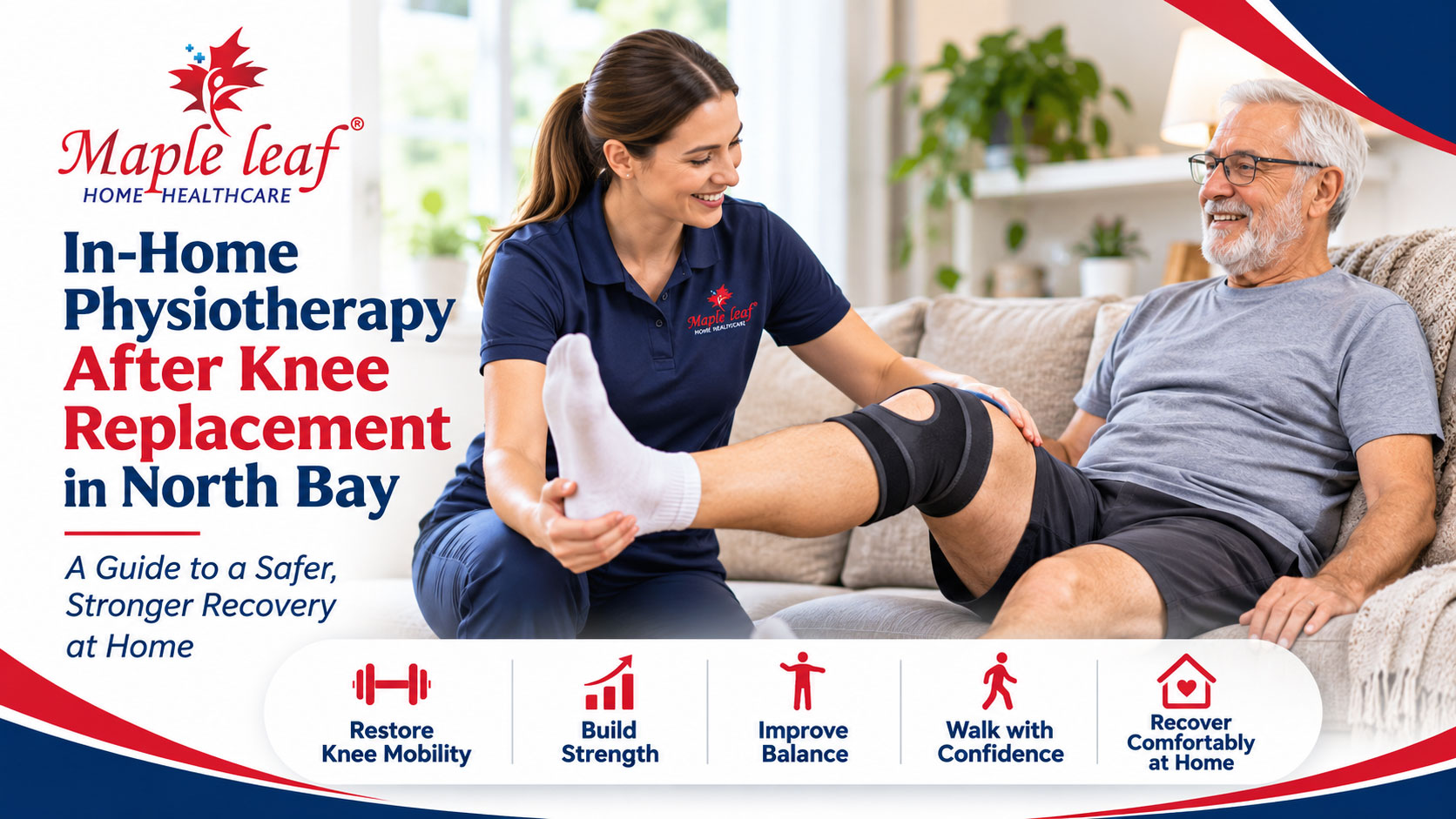
A knee replacement can make a significant difference to someone living with ongoing knee pain and reduced mobility. But getting through surgery is only one part of the journey. The weeks and months that follow are also important, as the body gradually adjusts and the person works towards regaining strength, movement and confidence.
For many people, everyday activities such as getting out of bed, walking across a room, climbing stairs or standing for longer periods can feel challenging during the early stages of recovery.
This is where an appropriate rehabilitation plan becomes important.
In-home physiotherapy after knee replacement in North Bay may be an option for eligible individuals who need professional rehabilitation support in their own surroundings. Depending on the surgeon’s instructions, clinical assessment and available services, physiotherapy can help patients work on knee movement, muscle strength, balance and everyday mobility.
At Maple Leaf Home Healthcare, we provide in-home physiotherapy services in North Bay, helping individuals explore rehabilitation support based on their needs and recovery goals.
In this guide, we explain what to expect after knee replacement surgery, how physiotherapy fits into recovery and what patients and families should consider when arranging rehabilitation at home.
☑️ Why Is Physiotherapy Important After Knee Replacement Surgery?
Knee replacement surgery involves replacing damaged joint surfaces with artificial components. Although the procedure is intended to improve pain and function, the surrounding muscles and tissues still need time and appropriate rehabilitation to recover.
After surgery, some people experience:
- Stiffness and reduced knee movement.
- Swelling around the operated knee.
- Muscle weakness, particularly around the thigh.
- Difficulty walking normally.
- Reduced balance and confidence when standing.
- Challenges with stairs and everyday activities.
These experiences can vary from one person to another.
Physiotherapy is an important part of knee replacement rehabilitation because it helps patients work towards restoring movement, strength and functional ability.
A physiotherapist can assess how the person is moving, identify areas that need attention and develop an exercise programme appropriate to their recovery stage.
The aim is not simply to bend the knee or complete a set of exercises. It is to help the individual gradually return to meaningful everyday activities as safely as possible.
☑️ Can You Receive Physiotherapy at Home After Knee Replacement Surgery?
Yes, home-based physiotherapy may be suitable for some people following knee replacement surgery.
The appropriate rehabilitation setting depends on several factors, including the patient’s medical condition, mobility, ability to travel, home environment, rehabilitation goals and the recommendations of their healthcare team.
Ontario’s clinical guidance recognises home-based rehabilitation as one of the possible settings for physiotherapy after hip or knee replacement. It also emphasises that rehabilitation should be timely and appropriate to the individual’s needs.
For someone who has difficulty travelling, home physiotherapy may offer a practical way to receive rehabilitation support in familiar surroundings.
However, it is important to understand that home physiotherapy is not automatically suitable for every patient. Some people may be better served by outpatient or hospital-based rehabilitation, while others may benefit from a combination of services.
The decision should be made with the treating healthcare team.
☑️ What Does In-Home Physiotherapy After Knee Replacement Involve?
A physiotherapy programme is not the same for everyone. The treatment approach depends on the patient’s progress, assessment findings and instructions from the surgeon.
Here are some areas that may form part of a rehabilitation programme.
A physiotherapy programme is not the same for everyone. The treatment approach depends on the patient’s progress, assessment findings and instructions from the surgeon.
Here are some areas that may form part of a rehabilitation programme.
✍️ 1. Improving Knee Movement and Flexibility
Following surgery, the knee may feel stiff and movement may be limited.
A physiotherapist can assess the available range of motion and guide the patient through appropriate movements and exercises.
The focus may include:
- Gradually improving knee bending.
- Working on comfortable knee straightening.
- Managing stiffness through prescribed movement.
- Monitoring changes in joint mobility.
Progress should be gradual and guided by the patient’s individual rehabilitation plan.
✍️ 2. Rebuilding Muscle Strength
Muscles around the knee and thigh may become weaker following surgery and a period of reduced activity.
A physiotherapist can introduce suitable strengthening exercises based on the patient’s recovery stage.
Depending on the assessment, rehabilitation may focus on:
- Quadriceps strength.
- Hamstring strength.
- Hip and lower-limb muscle strength.
- Controlled movement during daily activities.
Building strength can help support walking, standing and other functional movements.
✍️ 3. Improving Walking and Mobility
Walking may feel different after knee replacement surgery. Some individuals initially depend on a walker or another mobility aid.
A physiotherapist can assess walking patterns and provide guidance on appropriate movement, posture and mobility progression.
Rehabilitation may involve:
- Walking technique.
- Safe use of prescribed mobility aids.
- Weight-bearing guidance where applicable.
- Improving walking confidence.
- Gradually progressing everyday movement.
Patients should continue using their walking aids until their healthcare professional advises that it is safe to reduce or stop using them.
✍️ 4. Balance and Coordination Training
Regaining confidence while standing and moving is another important part of rehabilitation.
After surgery, weakness, discomfort and changes in walking patterns may affect balance.
A physiotherapist may introduce appropriate balance and coordination activities as the patient progresses.
These exercises should be selected according to the person’s abilities and should only be performed with the level of support recommended by the treating professional.
✍️ 5. Returning to Everyday Activities
The real purpose of rehabilitation is to help people manage their everyday lives more comfortably.
This may include working towards activities such as:
- Getting in and out of a chair.
- Moving safely around the home.
- Managing suitable stair activities.
- Standing for everyday tasks.
- Walking short distances.
- Completing appropriate personal care activities.
A home-based physiotherapy assessment can also help identify practical movement challenges within the person’s actual living environment.
☑️ What Happens During the Different Stages of Knee Replacement Recovery?
Recovery following knee replacement surgery is a gradual process. There is no single timeline that applies to everyone.
The following stages are general descriptions, not a prescribed treatment schedule.
✍️ Early Recovery: Getting Comfortable With Movement
The initial period after surgery focuses on following discharge instructions, managing symptoms and beginning appropriate movement.
Patients may need assistance with walking, transfers and everyday activities.
The hospital team will usually provide instructions about prescribed exercises, mobility aids and follow-up care.
Any rehabilitation programme should follow these instructions.
✍️ Building Strength and Movement
As recovery progresses, the patient may work towards improving knee movement, muscle strength and walking ability.
A physiotherapist can review progress and adjust the programme according to the person’s response and clinical goals.
Consistency with the prescribed home exercise programme is important, but exercises should never be increased beyond professional guidance.
✍️ Returning to Daily Routines
Later rehabilitation may focus on functional independence and gradually returning to activities that matter to the individual.
This could include walking for longer periods, managing stairs where appropriate and participating in normal household routines.
The pace of recovery varies according to health, fitness, surgical factors and individual progress.
☑️ How to Prepare Your Home for Knee Replacement Recovery
The home environment can make a difference to how comfortably someone manages everyday activities after surgery.
Before returning home, families may find it helpful to consider the following:
✍️ Keep Walking Areas Clear
Remove loose rugs, electrical cables and unnecessary furniture from frequently used walking routes.
Ensure there is enough room to move safely with a walker or other prescribed mobility aid.
✍️ Arrange Frequently Used Items Within Easy Reach
Place everyday items at a comfortable height to reduce unnecessary bending or reaching.
✍️ Plan for Bathroom Safety
Discuss appropriate bathroom equipment with the healthcare team. Depending on the person’s needs, this may include grab bars, a shower seat or other recommended support.
✍️ Consider a Suitable Sleeping and Resting Area
Make sure the person can access their resting area safely and that essential items are nearby.
✍️ Arrange Help With Everyday Activities
During early recovery, household tasks such as cooking, cleaning, laundry and shopping may require assistance.
Families can plan for support in advance rather than waiting until difficulties arise.
The hospital discharge team or treating professionals should advise on any specific home modifications or equipment requirements.
☑️ When Should You Contact a Healthcare Professional During Recovery?
Some discomfort, swelling and stiffness may occur during recovery, but patients and families should know when a change needs attention.
Contact the treating healthcare team if symptoms are worsening or if there are concerns about recovery.
Seek urgent medical attention for warning signs such as:
- New or sudden shortness of breath or chest pain.
- Significant calf pain or swelling, particularly if sudden.
- Fever or feeling significantly unwell.
- Increasing redness, warmth or discharge around the surgical wound.
- Worsening pain or swelling that is not improving as expected.
- Sudden difficulty bearing weight or moving the operated leg.
Chest pain or sudden breathing difficulty may indicate a medical emergency. Call 911.
Do not rely on physiotherapy sessions to assess or manage potentially serious post-operative complications.
☑️ How to Choose the Right In-Home Physiotherapy Service in North Bay
If you are considering physiotherapy at home after knee replacement, it is important to select a provider that understands your rehabilitation requirements.
Here are a few things to discuss before starting.
✍️ Professional Qualifications
Confirm that the physiotherapist providing treatment is appropriately qualified and registered to practise in Ontario.
✍️ Individual Assessment
Rehabilitation should be based on an assessment of the patient’s mobility, strength, movement and recovery goals.
✍️ Communication With the Healthcare Team
The physiotherapy provider should understand relevant post-operative instructions and any precautions provided by the surgeon.
✍️ Treatment Planning
Ask how progress is reviewed, how exercises are adjusted and how the treatment plan relates to the patient’s everyday goals.
✍️ Home Visit Availability
Confirm the service area, appointment availability, scheduling arrangements and any associated costs before beginning treatment.
☑️ In-Home Physiotherapy in North Bay with Maple Leaf Home Healthcare
Recovering from knee replacement surgery involves more than attending appointments. It also involves rebuilding confidence, gradually improving movement and learning how to manage everyday activities again.
For individuals who are suitable for home-based rehabilitation, receiving physiotherapy in familiar surroundings may provide a convenient alternative to travelling for every session.
Maple Leaf Home Healthcare provides in-home physiotherapy services in North Bay, with rehabilitation support based on individual requirements and professional assessment.
Our broader home healthcare services may also help families explore additional support where needed, including:
- Home Nursing Care.
- Personal Support Worker and Homemaking Services.
- Wound Management.
- Foot Care.
- Massage Therapy.
- Mobile Support Services.
- Residential and Commercial Cleaning.
Not every patient will need all these services. The appropriate combination depends on individual circumstances, clinical instructions and service availability.
[H3] Discuss Your Physiotherapy Requirements
If you or a family member is preparing for recovery following knee replacement surgery, speak with Maple Leaf Home Healthcare about available in-home physiotherapy services.
Our team can discuss your location, rehabilitation requirements and appointment options.
Maple Leaf Home Healthcare
Address: 36 Lakeshore Drive, North Bay, ON P1A 2A1
Phone: 705-303-8787
Toll-Free: 1-888-393-0001
Website: https://mlhealthcare.ca/
Serving North Bay and surrounding communities.
☑️ Frequently Asked Questions About Physiotherapy After Knee Replacement
✍️ Is physiotherapy necessary after knee replacement surgery?
Rehabilitation is an important part of recovery following knee replacement. Physiotherapy can help patients work on knee movement, strength, walking and everyday function. The appropriate rehabilitation programme should be determined by the treating healthcare team.
✍️ Can I receive physiotherapy at home after knee replacement surgery in North Bay?
Home-based physiotherapy may be suitable for some patients, depending on their medical condition, mobility, rehabilitation needs and service availability. A healthcare professional can help determine the appropriate setting.
✍️ How long does recovery from knee replacement surgery take?
Recovery varies between individuals. It depends on factors such as age, general health, surgical factors, physical condition and rehabilitation progress. Patients should follow their surgeon’s and physiotherapist’s guidance rather than comparing their recovery with someone else’s timeline.
✍️ What exercises are recommended after knee replacement?
Exercises may focus on knee movement, muscle strengthening, walking and functional mobility. The specific exercises, frequency and intensity should be prescribed by the treating physiotherapist or surgical team.
✍️ Can seniors benefit from in-home physiotherapy after knee surgery?
Some seniors may benefit from home-based physiotherapy if they are suitable for this type of rehabilitation. The treatment plan should consider their mobility, general health, home environment and recovery goals.
✍️ Should I continue using a walker after knee replacement?
Use a walker or other prescribed mobility aid until your physiotherapist or surgeon advises that it is safe to change. Do not stop using an aid simply because walking feels easier on a particular day.
✍️ Does Maple Leaf Home Healthcare provide physiotherapy at home in North Bay?
Yes. Maple Leaf Home Healthcare lists in-home physiotherapy among its services in North Bay. Contact the team to discuss your requirements, availability and suitability for home-based treatment.
☑️ Taking the Next Step Towards Better Mobility
Knee replacement surgery can be an important step towards improving comfort and mobility, but rehabilitation remains an essential part of the journey.
With appropriate professional guidance, a suitable exercise programme and support that reflects individual needs, patients can work towards regaining strength and returning to everyday activities.
For families exploring in-home physiotherapy after knee replacement in North Bay, Maple Leaf Home Healthcare can help discuss available rehabilitation support.
Contact Maple Leaf Home Healthcare
Phone: 705-303-8787
Toll-Free: 1-888-393-0001
Website: https://mlhealthcare.ca/
👉 Personal Support Worker Services
👉 About Maple Leaf Home Healthcare