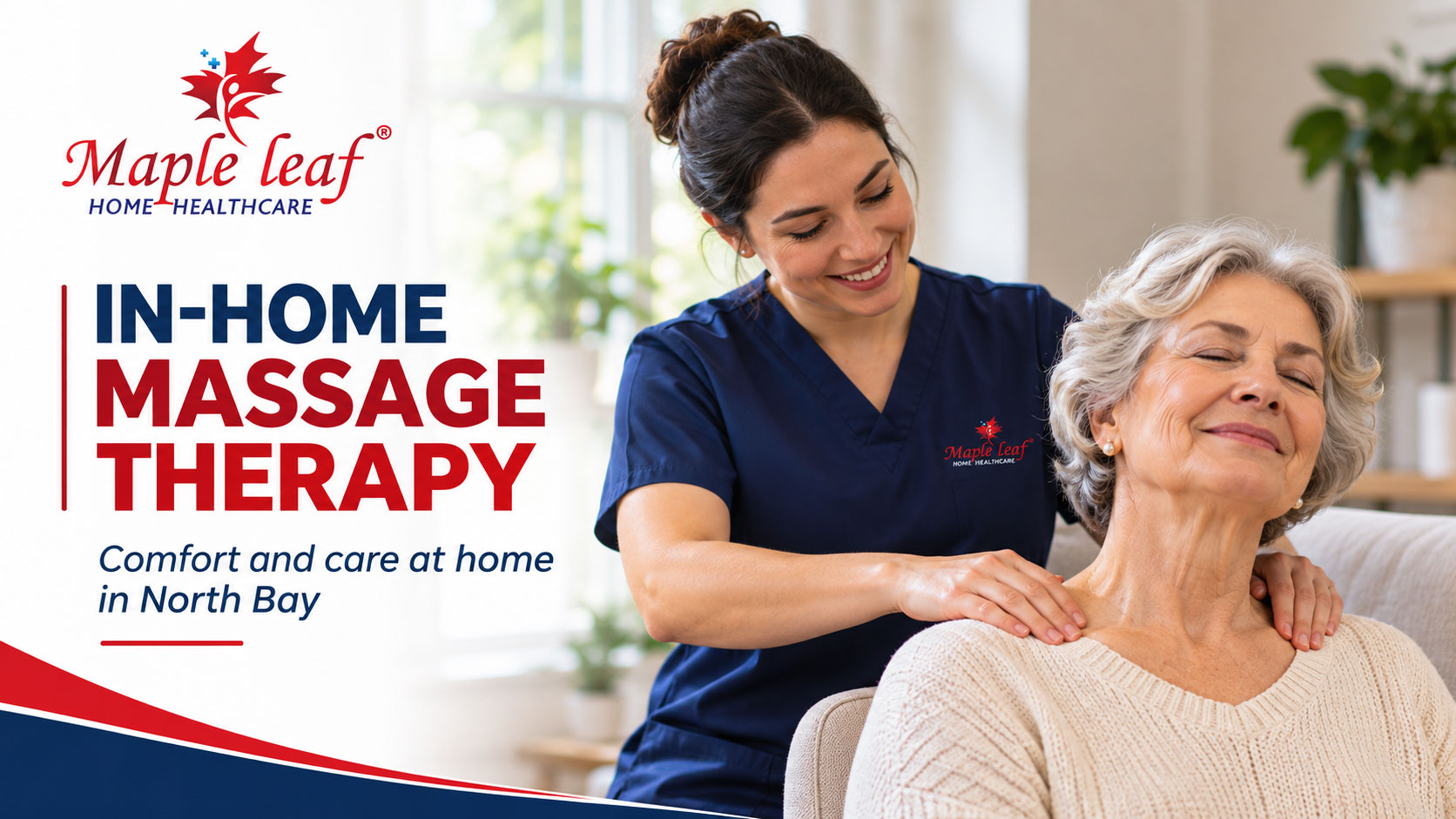
Finding time to attend regular appointments can become challenging when mobility, transportation or everyday responsibilities make travelling difficult. For individuals who prefer receiving care in familiar surroundings, in-home massage therapy in North Bay offers an alternative to travelling to a traditional clinic.
Massage therapy focuses on the assessment and treatment of soft tissues and joints within the professional’s scope of practice. Depending on an individual’s needs and suitability, treatment may address physical discomfort, muscle tension and movement-related concerns.
For older adults, people with mobility limitations and individuals who find travel difficult, having massage therapy available at home may make accessing this service more convenient.
Maple Leaf Home Healthcare provides massage therapy among its in-home healthcare services in North Bay and surrounding communities. This guide explains what families should know about home-based massage therapy, how appointments work and what to consider before arranging a session.
✍️ What Is In-Home Massage Therapy?
In-home massage therapy is a service delivered at a client’s residence rather than at a dedicated clinic.
The professional brings the appropriate equipment and conducts the appointment in a suitable space within the home. The session is planned around the client’s individual needs, health history, comfort and treatment goals.
In Ontario, massage therapy is a regulated health profession. Its scope includes assessing soft tissues and joints and treating or helping prevent physical dysfunction and pain through appropriate manual techniques.
The College of Massage Therapists of Ontario (CMTO) regulates the profession and establishes standards for safe and ethical practice.
For more information, visit the College of Massage Therapists of Ontario.
✍️ Who May Benefit From Massage Therapy at Home?
In-home massage therapy may be worth considering for individuals who have difficulty travelling to appointments or prefer receiving appropriate treatment in a familiar environment.
☑️ 1. Older Adults Experiencing Muscle Stiffness
Some older adults experience stiffness or physical discomfort that affects their daily routines.
An appropriately assessed massage therapy session may help address soft-tissue tension and discomfort, depending on the individual’s circumstances and suitability for treatment.
☑️ 2. Individuals With Limited Mobility
Travelling to a clinic can be difficult for someone who has reduced mobility, difficulty using stairs or challenges accessing transportation.
Home-based appointments can remove some of these practical barriers while allowing the therapist to consider the client’s available space and positioning needs.
☑️ 3. Individuals Experiencing Everyday Muscle Tension
Prolonged sitting, repetitive activities, physical work and reduced movement can contribute to muscle tension.
Massage therapy may be considered as part of an individual’s broader approach to managing physical discomfort, where clinically appropriate.
☑️ 4. People Who Prefer Receiving Care at Home
Some individuals feel more comfortable receiving services in familiar surroundings.
An in-home appointment can allow clients to avoid travelling, waiting rooms and the additional arrangements sometimes required to attend clinic-based appointments.
☑️ 5. Individuals Looking for Complementary Physical Care
Massage therapy may form one part of a wider healthcare plan.
Depending on individual needs, it may complement other services such as physiotherapy or nursing care. These professions have different scopes of practice and should not be treated as interchangeable.
✍️ What Are the Potential Benefits of In-Home Massage Therapy?
The suitability and outcomes of massage therapy vary between individuals. However, an appropriately planned session may offer several practical advantages.
☑️ Convenience and Accessibility
Receiving massage therapy at home removes the need to arrange transportation to a clinic.
This may be particularly useful for people who experience mobility limitations or find travelling physically demanding.
☑️ Individual Attention
An appointment provides an opportunity for the therapist to understand the client’s concerns, discuss relevant health information and plan treatment according to individual needs.
☑️ A Familiar Environment
Receiving treatment at home allows individuals to remain in surroundings they already know.
This can make appointment planning easier for people who prefer familiar spaces and established routines.
☑️ Attention to Soft-Tissue Discomfort
Massage therapy focuses on soft tissues and joints within the profession’s regulated scope.
Depending on the assessment, treatment may address areas of muscle tension, physical discomfort and movement-related concerns.
☑️ Integration With a Wider Care Plan
For some clients, massage therapy may be one component of a broader approach to maintaining physical wellbeing.
Where appropriate, families can discuss how different healthcare services may complement one another without replacing necessary medical treatment or rehabilitation.
✍️ What Happens During an In-Home Massage Therapy Appointment?
Knowing what to expect can help individuals and families feel more prepared before arranging a home appointment.
☑️ Step 1: Initial Discussion and Assessment
The therapist discusses the client’s concerns, relevant health history, treatment preferences and goals.
This information helps determine whether massage therapy is appropriate and what precautions may be required.
☑️ Step 2: Preparing a Suitable Space
A clean, accessible and comfortable area is selected for the appointment.
The therapist considers the available space, equipment requirements and the client’s ability to move into a suitable treatment position.
☑️ Step 3: Planning the Treatment
The treatment approach is based on the assessment and the client’s individual circumstances.
The therapist should explain the proposed treatment, obtain informed consent and discuss any relevant precautions.
☑️ Step 4: Conducting the Session
Treatment is provided using techniques appropriate to the client’s needs and within the therapist’s professional scope.
The client should communicate if they experience discomfort or want the treatment adjusted or stopped.
☑️ Step 5: Discussing Follow-Up
After the appointment, the therapist can discuss relevant observations, aftercare recommendations and whether further sessions may be appropriate.
The frequency and duration of treatment depend on individual needs rather than a standard schedule for everyone.
✍️ Is Massage Therapy Safe for Seniors?
Massage therapy is not automatically suitable for every person or health condition.
Older adults may have additional considerations, including fragile skin, osteoporosis, circulation-related concerns, recent surgery, medications that affect bleeding or bruising, and other medical conditions.
A qualified professional should review relevant health information before deciding whether treatment is appropriate.
Families should disclose:
- Existing medical conditions.
- Recent injuries or surgical procedures.
- Known allergies or skin sensitivities.
- Medications that may affect bruising or bleeding.
- Areas of pain, swelling or unusual tenderness.
- Any instructions or restrictions provided by the healthcare team.
Treatment should be modified, postponed or avoided when the assessment indicates that it is not appropriate.
Massage therapy should not be used as a substitute for medical assessment when someone has unexplained, severe or worsening symptoms.
✍️ Massage Therapy vs. Physiotherapy: Understanding the Difference
Massage therapy and physiotherapy are separate healthcare professions. Although they may complement each other, they have different purposes and treatment approaches.
| Area | Massage Therapy | Physiotherapy |
|---|---|---|
| Primary focus | Soft tissues and joints | Physical function and movement |
| Common approach | Manual soft-tissue techniques | Exercise, rehabilitation and other clinical interventions |
| Treatment goals | Address physical dysfunction, discomfort and soft-tissue concerns | Improve or restore physical function, strength and mobility |
| Individual planning | Based on assessment and treatment suitability | Based on assessment, functional goals and rehabilitation needs |
For example, someone experiencing muscle tension may discuss whether massage therapy is appropriate. Someone recovering from an injury or surgery and needing structured rehabilitation may require physiotherapy.
In some circumstances, both services may form part of a broader care plan.
Maple Leaf Home Healthcare also provides in-home physiotherapy services.
✍️ How to Prepare for a Massage Therapy Appointment at Home
A little preparation can help make the appointment more comfortable and organised.
Families and clients can consider the following:
- Choose an accessible space: Make sure there is sufficient room for the treatment equipment and safe movement.
- Share relevant health information: Inform the therapist about medical conditions, injuries, medications and previous treatment.
- Discuss comfort preferences: Explain any areas of discomfort, positioning concerns or treatment preferences.
- Wear comfortable clothing: Follow the therapist’s instructions about suitable clothing and treatment preparation.
- Keep the environment comfortable: Ensure the room has suitable lighting, temperature and privacy.
- Ask questions: Clarify the treatment approach, expected session duration and any aftercare guidance.
Clients should never feel pressured to proceed with a treatment they are uncomfortable with.
✍️ What Should Families Look for When Choosing a Massage Therapist in North Bay?
Choosing an appropriate provider is important, particularly when arranging treatment for an older family member or someone with additional health considerations.
Before booking, consider the following:
☑️ Verify Professional Registration
In Ontario, the titles Registered Massage Therapist (RMT) and Massage Therapist (MT) are protected professional titles.
If the provider is offering regulated massage therapy under these titles, verify their registration through the College of Massage Therapists of Ontario.
☑️ Ask About In-Home Service Availability
Confirm whether the provider offers appointments at the client’s residence and whether the service area includes the person’s location in North Bay.
☑️ Discuss Health and Safety Considerations
Ask how the therapist assesses suitability for treatment and accommodates relevant medical conditions, mobility limitations and positioning requirements.
☑️ Understand the Service and Costs
Before arranging an appointment, clarify session duration, fees, cancellation arrangements and whether receipts are available for eligible insurance claims.
☑️ Consider Coordination With Other Healthcare Providers
Where a client receives multiple healthcare services, appropriate communication and coordination can help ensure that treatment plans remain consistent.
✍️ In-Home Massage Therapy in North Bay With Maple Leaf Home Healthcare
For individuals and families searching for massage therapy in North Bay, receiving appropriate care at home may offer a convenient alternative to travelling for appointments.
Maple Leaf Home Healthcare lists massage therapy among its home healthcare services, alongside:
- Home Nursing Care
- Personal Support Worker and Homemaking Services
- Foot Care
- Wound Management
- Physiotherapy
- Massage Therapy
- Travel Nursing and Staffing Solutions
- Maple Leaf Cleaning Services
The appropriate service depends on the client’s needs and the availability and suitability of the service.
Families can contact Maple Leaf Home Healthcare to discuss in-home massage therapy, ask about service availability and understand the next steps before booking.
Explore the complete range of Maple Leaf Home Healthcare services.
✍️ Frequently Asked Questions About Massage Therapy in North Bay
☑️ 1. Is in-home massage therapy available in North Bay?
Maple Leaf Home Healthcare lists massage therapy among its services. Contact the team to confirm current in-home appointment availability and whether your location can be accommodated.
☑️ 2. Can seniors receive massage therapy at home?
Yes, some older adults may be suitable candidates for in-home massage therapy. An individual assessment is important to identify health considerations and determine an appropriate treatment approach.
☑️ 3. What does an in-home massage therapy session involve?
An appointment generally involves an initial discussion, relevant health assessment, treatment planning, the massage therapy session and follow-up guidance. The exact process depends on the client’s needs.
☑️ 4. Is massage therapy the same as physiotherapy?
No. Massage therapy focuses on soft tissues and joints through appropriate manual techniques, while physiotherapy addresses physical function, movement and rehabilitation. The services may complement each other.
☑️ 5. How often should someone receive massage therapy?
There is no single schedule suitable for everyone. Treatment frequency depends on the individual’s assessment, goals, response to treatment and professional recommendations.
☑️ 6. What health information should I share before a massage therapy appointment?
Share relevant medical conditions, recent surgeries or injuries, medications, allergies, skin sensitivities and any treatment restrictions. This helps the therapist assess whether treatment is appropriate.
☑️ 7. How do I choose a massage therapist in Ontario?
Check the professional’s registration with the College of Massage Therapists of Ontario if they are providing regulated massage therapy. Also discuss their experience, assessment process, service arrangements and fees.
☑️ 8. Does Maple Leaf Home Healthcare offer massage therapy?
Yes. Massage Therapy is listed among Maple Leaf Home Healthcare’s services in North Bay and surrounding communities. Contact the team to confirm current availability and appointment arrangements.
✍️ Explore In-Home Massage Therapy in North Bay
Accessing appropriate healthcare should be practical and suited to an individual’s circumstances.
For people who prefer receiving treatment at home or find travelling difficult, in-home massage therapy may be an option worth exploring following an appropriate assessment.
Maple Leaf Home Healthcare provides a range of in-home healthcare services for individuals and families in North Bay and surrounding communities.
Contact Maple Leaf Home Healthcare
Phone: 705-303-8787
Toll-Free: 1-888-393-0001
Address: 36 Lakeshore Drive, North Bay, ON P1A 2A1
Website: https://mlhealthcare.ca/
Contact Maple Leaf Home Healthcare to discuss massage therapy availability and arrange an in-home consultation.
👉 In-Home Massage Therapy in North Bay
👉 In-Home Physiotherapy Services
👉 Maple Leaf Home Healthcare Services
👉 Contact Maple Leaf Home Healthcare
👉 About Maple Leaf Home Healthcare
👉 College of Massage Therapists of Ontario